

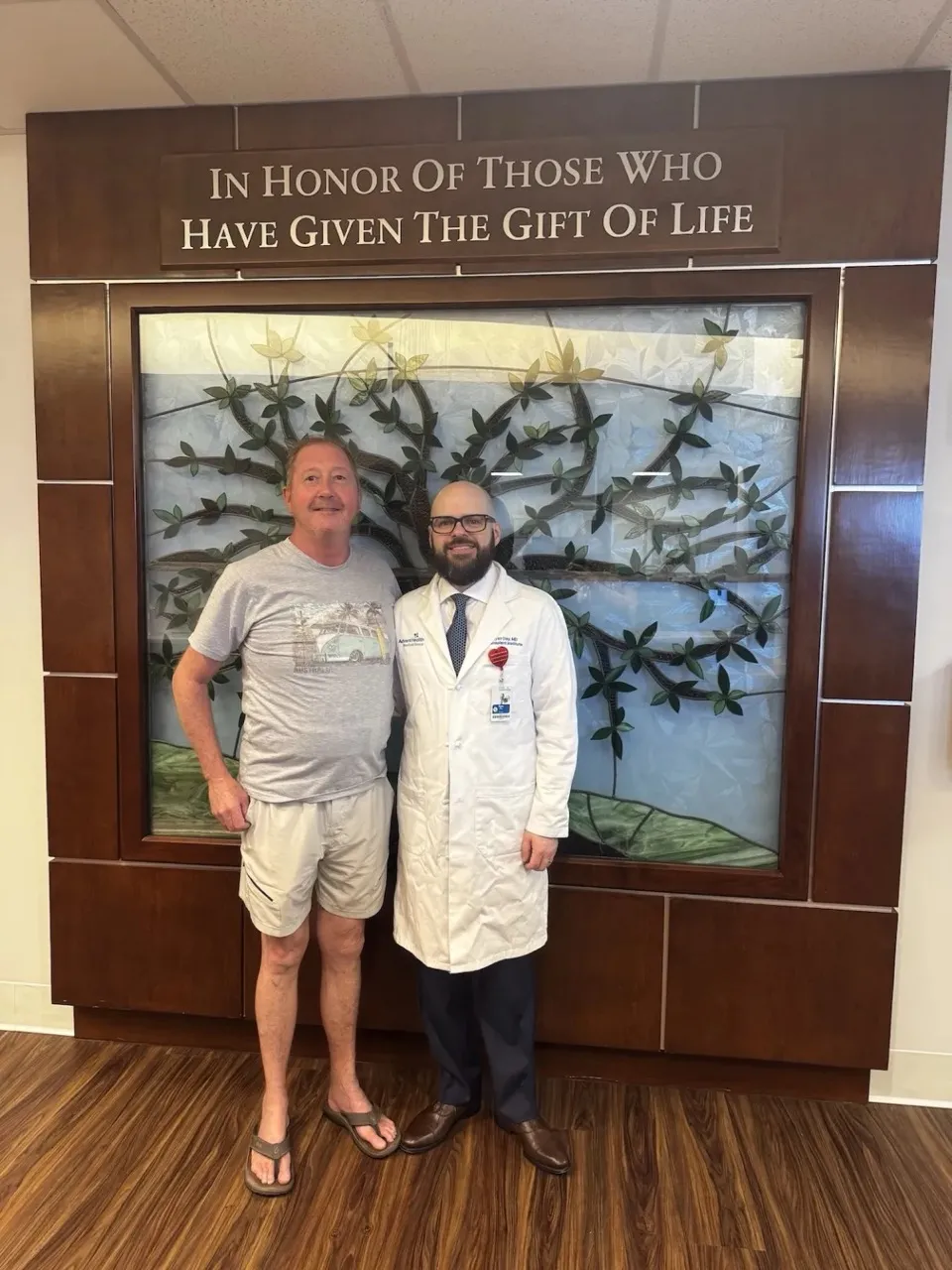
When Maurice Lindsay was diagnosed with stage IV colorectal cancer in 2022, his life changed overnight.
The cancer had already spread to his liver, and surgery was not an option. Over the next few years, Lindsay underwent chemotherapy and later received a specialized treatment that delivered medicine directly to his liver. While those treatments helped slow the disease, complications eventually meant they could no longer continue.
By early 2025, Lindsay had reached the end of available treatment options.
That’s when his care team at AdventHealth Transplant Institute offered him something new: a liver transplant, an approach not previously used in Central Florida for people with this type of advanced colorectal cancer.
In June, a multidisciplinary team led by AdventHealth abdominal transplant surgeon and surgical oncologist Dr. Ryan Day, performed the transplant. Today, Lindsay is doing well and is off chemotherapy for the first time in three years.
“He had come to the end of his available treatment options,” said Dr. Day. “This liver transplant provided him with a new start on life and a shot at a cure for his cancer.”
“Our team is committed to advancing care by making every possible effective treatment option available to our patients.” – Dr. Ryan Day
Why this matters for patients
Colorectal cancer is one of the most common cancers in the United States. For many patients, the liver is where the cancer spreads first. When the disease cannot be removed surgically, treatment options can become limited — and for families — the road can feel uncertain and overwhelming.
For years, liver transplants were only used for certain primary liver cancers. But advances in cancer treatment, careful patient selection, and transplant medicine are opening new possibilities for people who previously had very few options.
For select patients, a liver transplant combined with chemotherapy can significantly improve long-term survival compared to chemotherapy alone, according to a study published in The Lancet.
“Colorectal cancer is an especially challenging disease to treat,” said Dr. Day. “Our team is committed to advancing care by making every possible effective treatment option available to our patients.” That commitment reflects AdventHealth’s promise to care for the whole person, not just the disease — with leading-edge medicine delivered alongside compassion and support.
A team that looks at the whole picture
Not every patient with advanced colorectal cancer is a candidate for a liver transplant. Each case is carefully reviewed to make sure this approach is both safe and appropriate — because doing what’s possible must always be matched with doing what’s right for the person.
Doctors look at how long the cancer has been stable, whether it has spread outside the liver, and a number of other medical factors. Patients must also meet the same standards required for any liver transplant.
“When evaluating patients and developing treatment plans, we involve medical oncologists, radiation oncologists, hepatologists, transplant surgeons, transplant psychiatrists, pulmonologists, cardiologists, social workers, dietitians and other specialists as needed,” said Dr. Day. “It is truly multidisciplinary, and when our medical team makes decisions about the best treatment pathway for a specific patient, we need consensus among the entire group.”
Learn more about the AdventHealth Transplant Institute
This integrated model reflects AdventHealth’s commitment to whole-person care — addressing the clinical complexity of cancer while also recognizing the emotional and spiritual challenges patients and families carry throughout the journey.
Thoughtful use of donor organs
Because donor organs are limited, AdventHealth works closely with organ procurement organizations, including OurLegacy, to ensure responsible and ethical use of every donated liver — honoring the generosity behind every donation and the lives it can touch.
The transplant team also uses advanced technology that allows doctors to carefully evaluate donor livers before surgery, helping expand the number of organs that can be safely used.
“I think we’re just beginning to explore this new frontier.” – Dr. Ryan Day
Looking ahead with hope
For Dr. Day, Lindsay’s story represents what is possible when innovation, compassion, and careful decision-making come together — in service of the person and the family who need hope most.
“Cases like Mr. Lindsay’s are why I pursued fellowship training in both surgical oncology and transplant medicine,” he said. “People used to think liver transplant for colorectal liver metastases wasn’t a viable treatment option, but with the tremendous advances we’ve made in cancer care, now it is. I think we’re just beginning to explore this new frontier, and I’m excited to see if we can uncover new applications and possibly even cures for a variety of cancers.”
For patients and families facing advanced cancer, stories like this offer something deeply meaningful: renewed hope, thoughtful care, and the possibility of a future once thought out of reach — supported by a team committed to helping people feel whole.
More than 100,000 people in the U.S. —including approximately 2,000 children— are waiting for a lifesaving transplant, and the need for organ donors is critical. Registering to be a donor is simple and takes just a few minutes. Florida residents can sign up by visiting: Donate Life Florida. Once person’s selfless gift can save eight lives.
12 items. To interact with these items, press Control-Option-Shift-Right Arrow. These items are in a slider. To advance slider forward, press Shift-Command-Right Arrow. To advance slider backward, press Shift-Command-Left Arrow.









Press Release
AdventHealth Sebring is growing to provide more advanced heart care options to Highlands County and beyond
AdventHealth Sebring is growing by adding more than 100,0000 square feet of new clinical space, expanding the hospital’s capacity and advancing the technology used to diagnose and treat heart disease...
News
DAISY Award goes to two nurses at AdventHealth Gordon
AdventHealth Gordon team members Ian Sorrow, RN, and Mellissa Pumphrey, RN, have been named DAISY Award recipients.
News
For one Palm Coast resident, a hard year of injuries mirrors a community trend
When 75-year-old Grand Haven resident Jan Weida looks back on the past year, she describes it as a time marked by unexpected setbacks and the steady support she relied on to keep moving forward.
News
AdventHealth Redmond named Blue Cross Blue Shield Blue Distinction® Center for Bariatric Surgery
AdventHealth Redmond has been recognized as a Blue Cross Blue Shield Blue Distinction® Center for Bariatric Surgery.
News
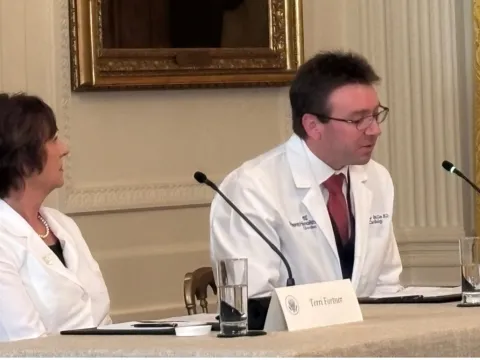
Improving rural communities’ access to high-quality care close to home
Federal leaders and providers met at the White House to discuss rural health care, including insight from AdventHealth Gordon’s Andrew McCue, MD.
News
AdventHealth Medical Group adds three orthopedic surgeons, expanding access to care in Volusia County
AdventHealth Medical Group has added three orthopedic surgeons in Volusia County.
News
AdventHealth Medical Group expands access to care in Summerville
AdventHealth Medical Group is excited to announce the opening of a new primary and urgent care clinic in Summerville this February.
News
Elisa Jaramillo-Mayor, MD, joins AdventHealth Medical Group Family Medicine at Adairsville Health Park
AdventHealth Medical Group is pleased to announce that Elisa Jaramillo-Mayor, MD, has joined AdventHealth Medical Group Family Medicine at Adairsville Health Park.
News
These whole-health habits may slow your brain’s aging, groundbreaking study reveals
AdventHealth researchers discovered that everyday movement may help support brain health long before memory or focus becomes a concern.
News
Tourist’s life saved through fate, teamwork and cutting-edge care
When a cardiac emergency struck at a local theme park, quick action from an AdventHealth team member played a crucial role in saving a life and reuniting a family.
News
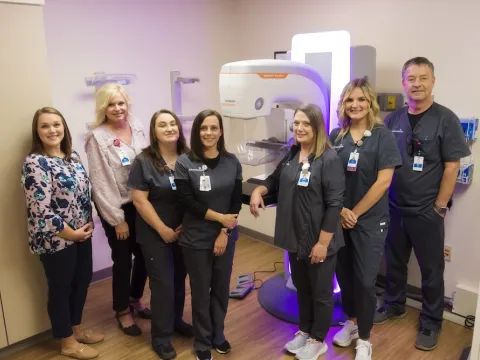
AdventHealth Murray earns American College of Radiology accreditation
AdventHealth Murray has been awarded a three-year term of accreditation in mammography by the American College of Radiology® (ACR®).
News
AdventHealth Porter Transplant Institute celebrates growth, innovation and lives transformed
For patients waiting for a second chance at life, time matters. So does trust, compassion, and the belief that healing is possible.